
The skin barrier is the outermost layer of the skin, which keeps moisture in and tiny irritants out. When it is intact, skin feels smooth and comfortable; when it weakens, skin feels tight and reacts easily. If you would like to give it some peace, have a look at cosmetics for sensitive skin, for example LONGEVITY Barrier Boost or the CICA face cream with centella. The Advisor can help you find what suits your skin.
What the skin barrier is: bricks and mortar
The easiest way to imagine it is as a wall. The flat cells of the surface layer are the bricks, and between them is mortar made of fatty substances, for example ceramides, cholesterol and fatty acids. While the mortar is whole, water escapes from the skin only slowly and whatever irritates your skin stays outside. When gaps appear in it, moisture leaves more easily and the skin reacts more sensitively to wind, fragrance and a new cream. That is why the skin barrier is not a product you can buy. It is a structure that needs water and lipids and, above all, peace, so that it has something to hold itself together with. You can read about ceramides and the barrier in studies on ceramides and the skin barrier, source PubMed.
How do you know your skin barrier has weakened?
It is not a diagnosis, more a summary of small things that keep repeating. Skin that tolerated its creams without trouble not long ago suddenly shows that something does not suit it. Notice whether any of these signs returns over several days in a row, not just after one unlucky shower or a walk in the frost. A single wobble does not mean anything yet, repetition does. Skin can often get back into shape by itself after a demanding day, so there is no need to change your whole routine straight away. It helps to note down for a few days what you put on your skin and how it looked in the morning and in the evening, so that you see the connections faster than by looking in the mirror. Signs of a weakened barrier can look like this, if they repeat for longer than a few days:
- after washing, your skin feels tight and wants cream sooner than usual,
- fine flakes appear on your cheeks or around your nose,
- your usual cream stings a little, although you know it well,
- your skin flushes easily after wind, heat or hot water,
- it reacts to things it used to tolerate without any problem.
If the redness is strong, the burning persists or appears for no obvious reason, speak to a doctor or dermatologist. Cosmetics do not replace an examination.
What strains the skin barrier in winter and on an ordinary day
With the barrier, it is the sum that counts, not one culprit. In winter, sharp wind combines with heating that dries the air in your home and a hot shower that we treat ourselves to because it is freezing outside. Add exfoliation two days in a row, a strongly foaming cleansing gel and a new product with several active ingredients, and the mortar may not cope. Skin likes peace: lukewarm water, gentle drying and fewer steps. In the morning, too, a few minutes are enough, slow application with your palms, and your skin gets time to recover. If you suspect something specific, go back to what you used before the change. Note down what changes and when. A diary of triggers is also discussed in the text on sensitive skin, which shows you how to tell lasting sensitivity from temporary irritation. It is useful reading.

What to give the skin barrier: water, lipids and peace
In the INCI, all three building blocks can be recognised by their names. The table shows what to look for and where you will find it in two creams whose composition is verified directly on the product pages.
| What the skin barrier needs | What to look for in the INCI | Where to find it |
|---|---|---|
| Water | Glycerin, Sodium Hyaluronate | Both Barrier Boost and the CICA cream |
| Lipids as the mortar | Ceramide NP, Butyrospermum Parkii Butter (shea butter), Helianthus Annuus Seed Oil | Barrier Boost, sunflower oil in both the CICA cream and Barrier Boost |
| Peace | Allantoin, Centella Asiatica Extract, Niacinamide | Barrier Boost (allantoin, niacinamide), CICA cream (centella) |
The order of ingredients helps: Aqua is in first place in both creams, in Barrier Boost it is followed by shea butter and glycerin, in the CICA cream by sunflower oil and glycerin. At the end of the list you will find preservatives, for example Sorbic Acid or Benzyl Alcohol. There is no Parfum or essential oil in the composition of either cream, which is good news for weakened skin. According to the manufacturer, Barrier Boost is intended for the morning in place of a day cream and has a pH of 5.5 to 5.8, close to that of skin, while the CICA cream has a lighter texture with sunflower and castor oil. Try a new cream first on a small area of skin and use it according to the label. Moisture is explained in the text on hydrating serum.
A gentle routine to support the skin barrier
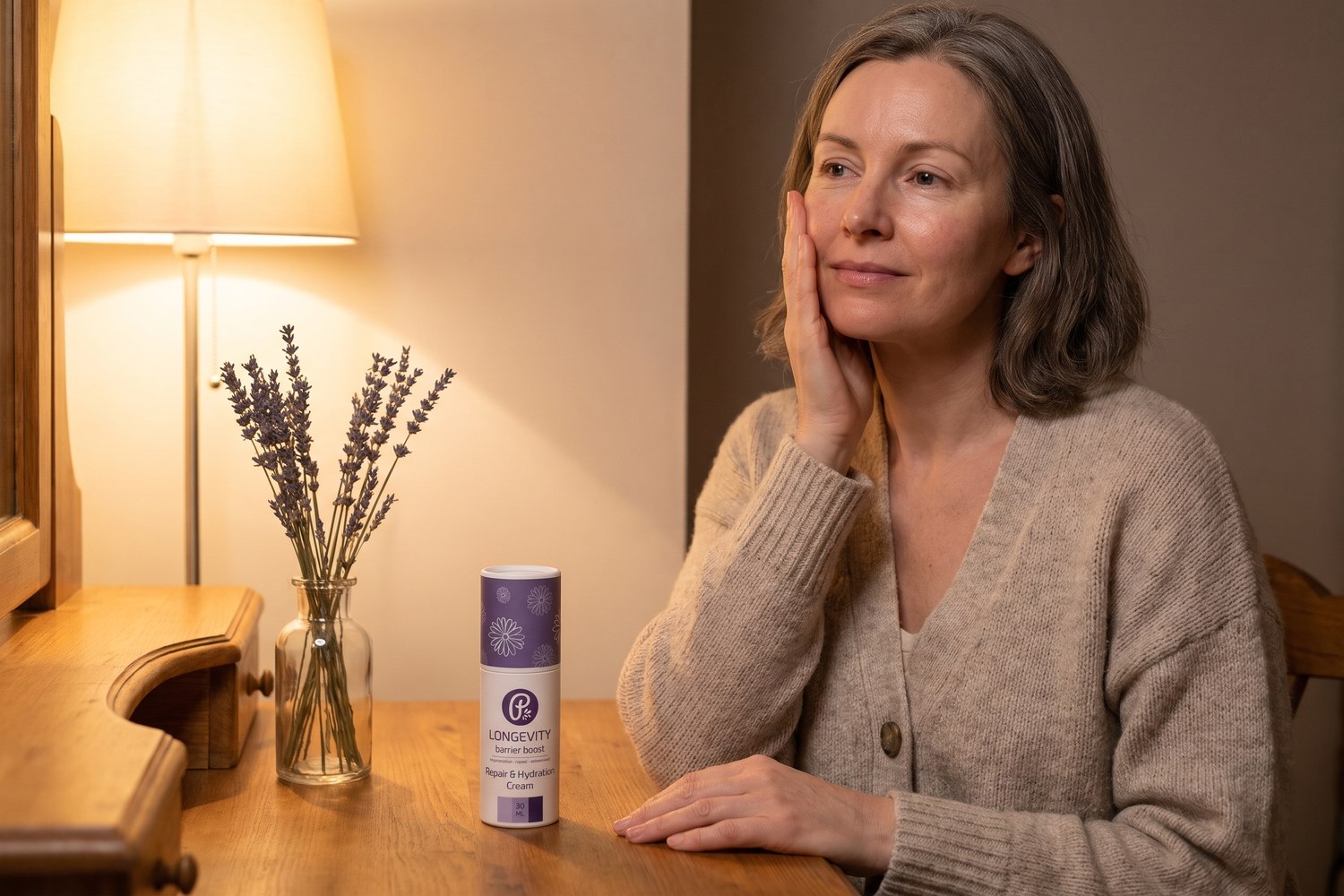
The routine that works best is one you can manage even when tired. Two to three steps in the morning and two in the evening. No novelties. The same in the evening. In the morning, a short moment at the basin is enough, a few slow movements and a cream you already know, and this ritual can be done even in pyjamas. If you skip something, nothing happens. Skin changes over weeks. Take your time when applying and let your palm rest on your cheek for a few seconds while the cream absorbs. Such a touch is a small ritual that slows you down too. During winter you may feel that your cream is not enough. Try applying a thinner layer and letting it settle, rather than adding more products. The skin barrier is also supported by doing nothing extra.
- Cleanse your skin with lukewarm water or a gentle product, without scrubbing.
- On slightly damp skin, apply cream according to the label and let it settle for a moment.
- While your skin is calming down, leave out exfoliation and several active ingredients at once.
- Introduce new products one at a time and watch how your skin takes them and whether it does well with them.
Did you know…
Did you know that there are fatty substances such as ceramides between the cells of the skin's surface layer, and that in cosmetics you can recognise them by names such as Ceramide NP?